
Solar landscape lights and wired low-voltage systems solve different problems. Solar can be a sensible choice for temporary markers, a rental, or a remote spot where digging or wiring is not practical and perfect consistency is not important. A designed low-voltage system is usually the better fit when you want reliable path lighting, layered architectural effects, mature-tree uplighting, coordinated controls, or a system that can be serviced and expanded.
That distinction matters in Raleigh, Cary, Apex, and Holly Springs, where mature tree cover, changing seasons, long driveways, patios, pools, irrigation, and dense landscaping can make a quick daytime fixture test misleading. The best choice depends on the job each light needs to do after dark.
The short answer
Choose solar when low upfront cost, simple placement, and no cable are more important than output consistency or precise control. Choose low voltage when the lighting supports safe movement, curb appeal, outdoor living, dependable schedules, or a specific design effect. Solar and low voltage can coexist, but the critical areas should not depend on a small panel that may spend part of the day in shade.
Solar and low voltage compared
- Upfront work: solar is usually place-and-test; low voltage requires a transformer, cable routes, connections, and load planning.
- Nightly consistency: solar output depends on panel exposure, battery condition, weather, and season; low voltage receives controlled power from the transformer.
- Shade: solar fixtures need useful daylight at their own panels; low-voltage fixtures can be placed under trees, eaves, and dense planting when the cable can reach them.
- Design choices: professional low-voltage systems offer more beam spreads, mounting options, output choices, shielding, and coordinated finishes.
- Controls: solar lights usually operate independently; wired systems can use timers, photocells, zones, smart controls, and coordinated color features.
- Service: many solar products are replaced as complete units; a professional system can be tested by circuit and serviced by component.
- Expansion: solar is easy to add one at a time; a low-voltage system can expand cleanly when transformer capacity and wire routes were planned in advance.
Where solar lighting makes sense
- Temporary markers for a party, seasonal display, or short-term rental.
- A sunny, remote garden location where running cable is not justified.
- Low-stakes decorative accents where changing brightness is acceptable.
- Testing whether you like having a light in a location before planning permanent work.
Place a solar fixture where its panel receives the exposure the manufacturer requires, not merely where the light looks good. Watch the result over several ordinary days, including cloudy weather, before relying on it.
Where low-voltage lighting earns its cost
Front architecture and entries
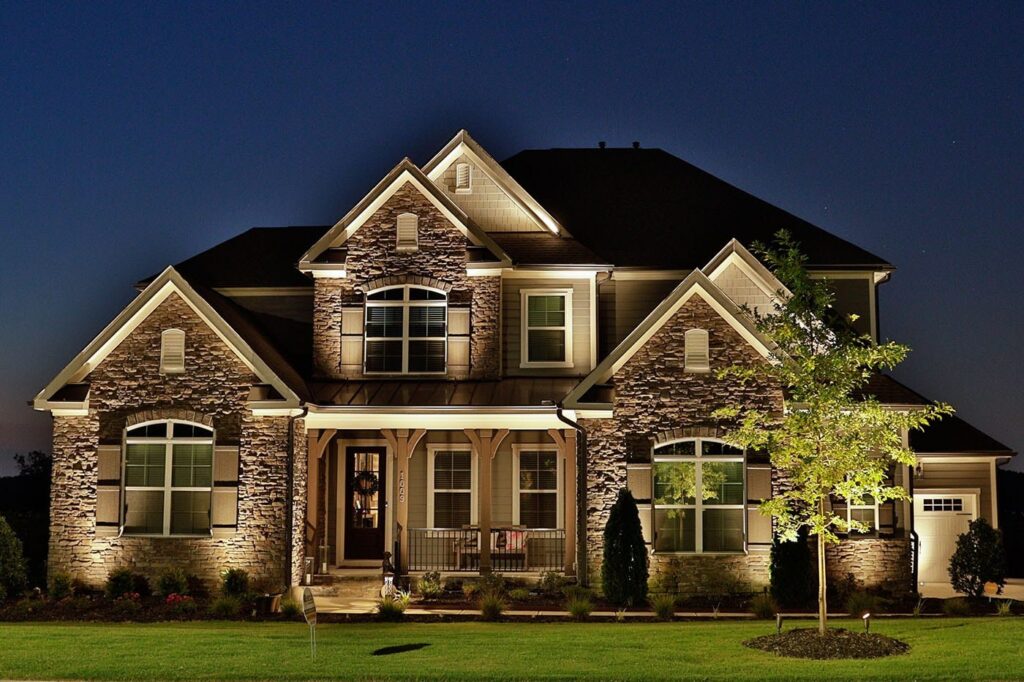
A front elevation usually needs several beam widths and mounting positions working together. Wired fixtures allow the designer to balance columns, rooflines, brick or stone texture, trees, and the entry instead of producing isolated bright spots.
Paths, steps, and long driveways
Areas used for movement need predictable light and careful glare control. A designed system can space fixtures around curves, elevation changes, and arrival points while placing the light source out of direct view. Solar may still mark an edge, but it should not be assumed to provide the same consistent scene every night.
Mature trees and shaded yards
The best location for illuminating a canopy may be one of the worst places to charge a solar panel. Low-voltage cable lets the fixture follow the design rather than the sunlight, with output and beam spread selected for the tree.
Pools, patios, and outdoor rooms
Outdoor living areas benefit from zones, schedules, dimming or scene choices, and careful control of reflections and glare. This is less about making the area bright and more about giving steps, edges, cooking areas, plantings, and gathering spaces the right amount of light.
Responsible outdoor lighting is about control, not maximum brightness
The U.S. Department of Energy recommends directing light only where it is needed, using the lowest useful amount, adding controls, and considering color carefully. Raleigh's lighting rules likewise emphasize aiming and shielding building and security lights toward the intended feature and away from adjoining property. Those principles are useful for residential landscape lighting even when a particular fixture is not governed by that section of code.
What a professional low-voltage plan should include
- A nighttime goal for each area rather than a fixture count alone.
- Fixture positions, beam choices, mounting details, and glare control.
- Transformer capacity, load calculations, wire routes, and connection methods.
- Zones, schedules, photocells, and controls matched to how the property is used.
- Allowance for plant growth, mowing, irrigation, drainage, and future service.
- Night aiming and balancing after installation.
- A plan for future expansion if the project will be phased.
A quick decision guide
- Sunny flower bed, temporary accent: try solar.
- Front elevation or curb appeal: choose a designed low-voltage system.
- Mature-tree uplighting: low voltage is usually the practical choice.
- Primary path, steps, or long driveway: choose consistent low-voltage lighting.
- Rental or no-dig temporary use: solar may be enough.
- Pool, patio, or multiple outdoor rooms: plan low-voltage zones and controls.
- Existing hardscape: have a professional review routes and mounting options before assuming either approach is impossible.
The honest answer is not that every solar light is bad or every wired fixture is good. The system succeeds when the power method, optics, placement, controls, and service plan fit the property and the job.