
A landscape lighting system rarely fails all at once. More often, one fixture flickers, a section of the yard goes dark, or the lights farthest from the transformer become noticeably dimmer. Those small symptoms are useful clues. They can point to a loose connection, damaged cable, a timer or photocell problem, a failing fixture, or a system that is no longer balanced correctly.
For Raleigh-area homeowners, seasonal growth, heavy rain, summer heat, landscape work, and storm cleanup can all change the conditions around a low-voltage system. Finding the real cause early is usually simpler than waiting until several fixtures stop working.
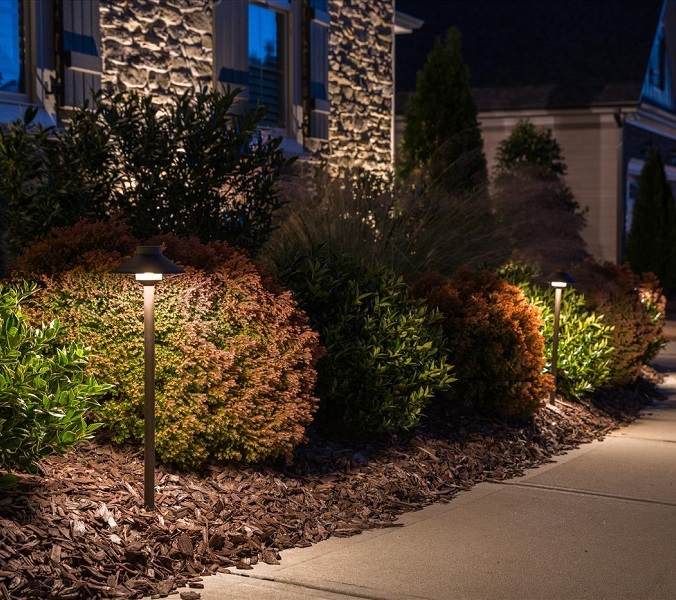
Six signs your outdoor lighting needs attention
1. The entire system is dark
Start with the obvious: confirm that the transformer has power and that the outlet or GFCI has not tripped. If power is present but the lights remain off, the issue may be inside the transformer, timer, photocell, controller, or main cable. That is the point to stop guessing and have the system diagnosed.
2. One zone or several nearby fixtures are out
When a group of lights fails together, the problem is often somewhere upstream of that group. A cut cable, failed splice, corrosion at a connection, or overloaded run can interrupt everything beyond it. Replacing bulbs one at a time will not solve a wiring problem.
3. Lights flicker or work only sometimes
Intermittent operation frequently points to a loose or moisture-affected connection. Flicker can also come from a failing lamp, driver, transformer, timer, or photocell. Because the symptom can have several causes, testing the circuit is faster and more reliable than swapping random parts.
4. Fixtures are dim, especially at the end of a run
A light that is bright near the transformer and weak farther away may be experiencing voltage drop. Long cable runs, undersized wire, too many fixtures on one run, or poor connections can all contribute. A technician can measure voltage at the transformer and at the fixtures, then rebalance the system instead of masking the problem with a brighter lamp.
5. The schedule no longer matches sunset
If the lights come on during the day, stay on all night, or fail to start at dusk, check the programmed schedule and make sure landscaping is not covering the photocell. A power interruption can reset some timers. Persistent timing problems may mean the control needs service or replacement.
6. The system works, but the design looks uneven
Plants grow, mulch gets added, fixtures are bumped, and tree canopies change. A working system can still lose its original effect. Cleaning lenses, trimming around fixtures, realigning beams, and moving lights to match mature landscaping can restore the design without starting over.
What you can safely check before scheduling repair
- Confirm the transformer is plugged in and the outlet has power.
- Reset a tripped GFCI once. If it trips again, leave it off and call a professional.
- Check that the timer or controller shows the correct time and schedule.
- Look for a fixture that was knocked over, buried by mulch, or covered by plant growth.
- Note which lights are affected and whether the problem is constant or intermittent.
Do not open a transformer, work on line-voltage wiring, or keep resetting a breaker or GFCI that trips repeatedly. Those symptoms need professional diagnosis.
What a professional outdoor lighting repair visit should include
A useful repair visit is more than replacing the first failed bulb. The technician should inspect the transformer and controls, test voltage, trace affected cable runs, check connections and fixtures, clean lenses, realign lights, and explain which repairs are necessary now versus what can wait.
Bolt Outdoor Lighting diagnoses and repairs existing low-voltage landscape lighting systems across Raleigh, Cary, Apex, Holly Springs, and the surrounding Triangle, including systems installed by another company. Existing-system diagnosis and repair is billed at $135 per hour, plus any needed materials.
Raleigh outdoor lighting repair questions
Can Bolt repair a system installed by someone else?
Yes. Bolt can diagnose and repair an existing landscape lighting system even if another contractor installed it. The first step is identifying what equipment is present and where the failure begins.
Is it better to repair or replace an older system?
That depends on the condition of the transformer, cable, connections, and fixtures. A targeted repair makes sense when the core system is sound. Widespread corrosion, repeated failures, or poor original wiring may make selective replacement more practical. A diagnosis should give you that answer before larger work begins.
How often should landscape lighting be maintained?
Most systems benefit from a periodic check after major plant growth, landscape work, or severe weather. Cleaning lenses and correcting fixture aim before failures appear also keeps the lighting design looking intentional.